


Published July 17, 2024. Updated May 5, 2026. Open access. | Purchase book ❯ |
Yellow-bellied Puffing-Snake (Spilotes sulphureus)
Reptiles of Ecuador | Serpentes | Colubridae | Spilotes sulphureus
English common name: Yellow-bellied Puffing-Snake.
Spanish common name: Culebra silbadora gigante.
Recognition: ♂♂ 291.5 cmMaximum distance from the snout to the tip of the tail. ♀♀ 234 cmMaximum distance from the snout to the tip of the tail..1,2 Spilotes sulphureus is readily identified by its massive size, its sulfur-yellow coloration, and its strongly keeled dorsal scales arranged in 19–21 rows at mid-body.3,4 Adult dorsal surfaces are typically a dull olive-yellow with bright yellow skin between the scales (Fig. 1), while the venter is a pale greenish-yellow.3–7 Juveniles exhibit a distinct ontogenetic color change, possessing a pattern of dark, oblique transverse bands across the dorsum.3–7 This species is distinguished from Xenodon severus by its keeled dorsal scales,3 and from its congener S. pullatus by its olive background coloration rather than the stark black-and-yellow contrast seen in the latter.
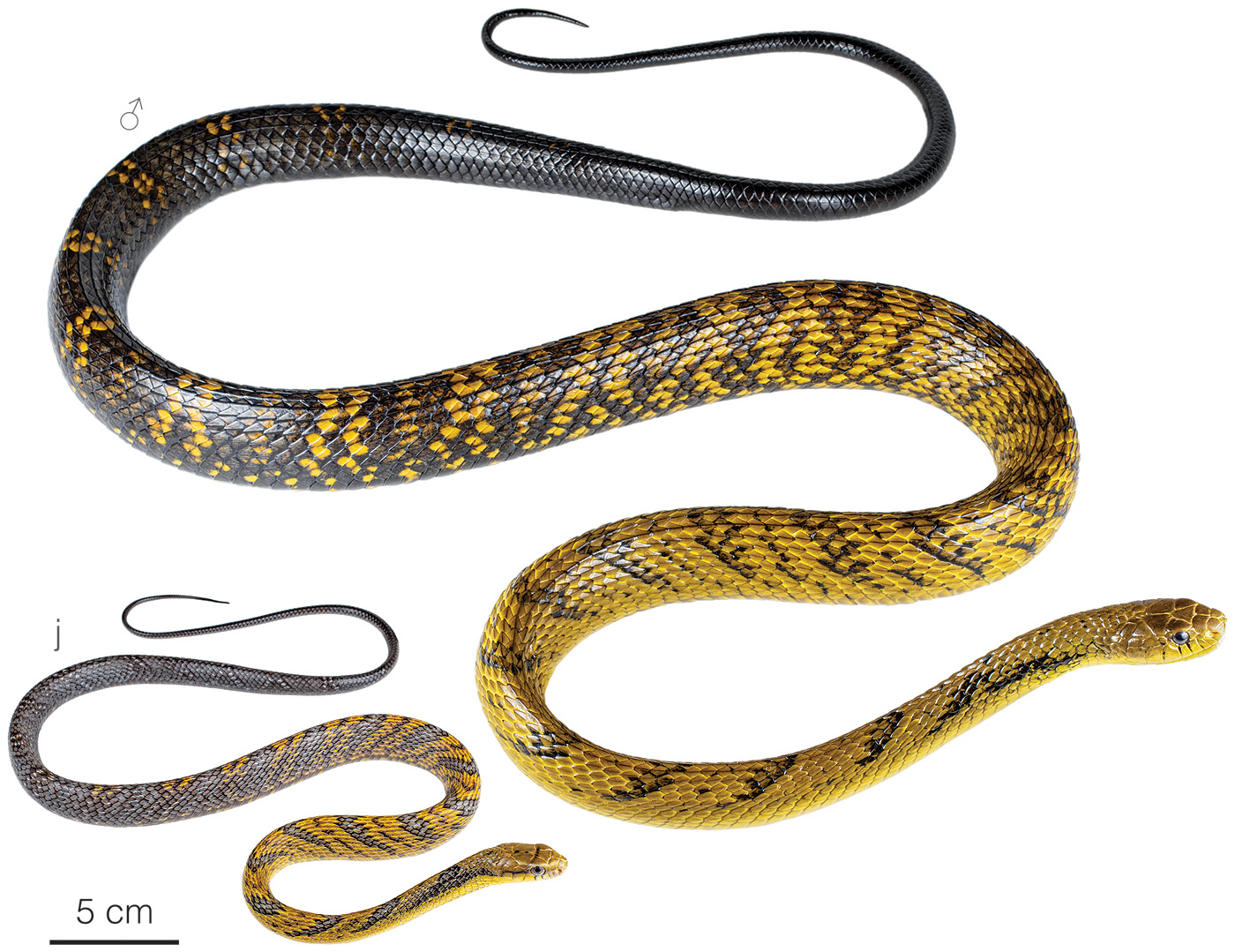
Figure 1: Individuals of Spilotes sulphureus from Suriname.
Natural history: Spilotes sulphureus is an uncommonly encountered diurnal snake with a versatile lifestyle, occupying arboreal and terrestrial niches across habitats ranging from primary rainforests to agricultural fields and even peri-urban areas.3,4,8 The species is most abundant along forest edges.5–12 Yellow Puffing Snakes are typically active during sunny intervals, foraging from the forest floor to the canopy level7,11,12; at night, they retreat to coiled sleeping positions on vegetation.13 Possessing aglyphous dentition (lacking specialized venom-conducting grooves), these snakes are powerful generalist predators. Their diet primarily consists of mammals, birds, and eggs—often leading them to raid poultry nests—but also includes lizards, frogs, fish, and vipers.4–15 Small prey is swallowed alive, while larger items are subdued via constriction. Reproduction involves clutches of 7–14 eggs, which are guarded by the female during an incubation period of 84–86 days.2,4–9 The species is well known for its dramatic defensive display: when threatened, it elevates the anterior half of its body, inflates the neck, and vibrates the tail.4,13 Additionally, ritualized male-to-male combat has been documented,10 and the species is occasionally preyed upon by ophiophagous snakes such as Clelia.15
By purchasing the hardcover or PDF of the Reptiles of Ecuador, you help keep this website 100% free.
Conservation: Least Concern Believed to be safe from extinction given current circumstances..16 Spilotes sulphureus is listed in this category on the basis of the species’ wide distribution, occurrence in numerous protected areas, and presumed large and stable populations densities.16
Distribution: Spilotes sulphureus is widely distributed throughout the Amazon lowlands of Bolivia, Brazil, Colombia, Ecuador (Fig. 2), French Guiana, Guyana, Perú, and Venezuela. The species also widespread across the Atlantic Forest of Brazil, with marginal records in the Cerrado and the Caatinga.17
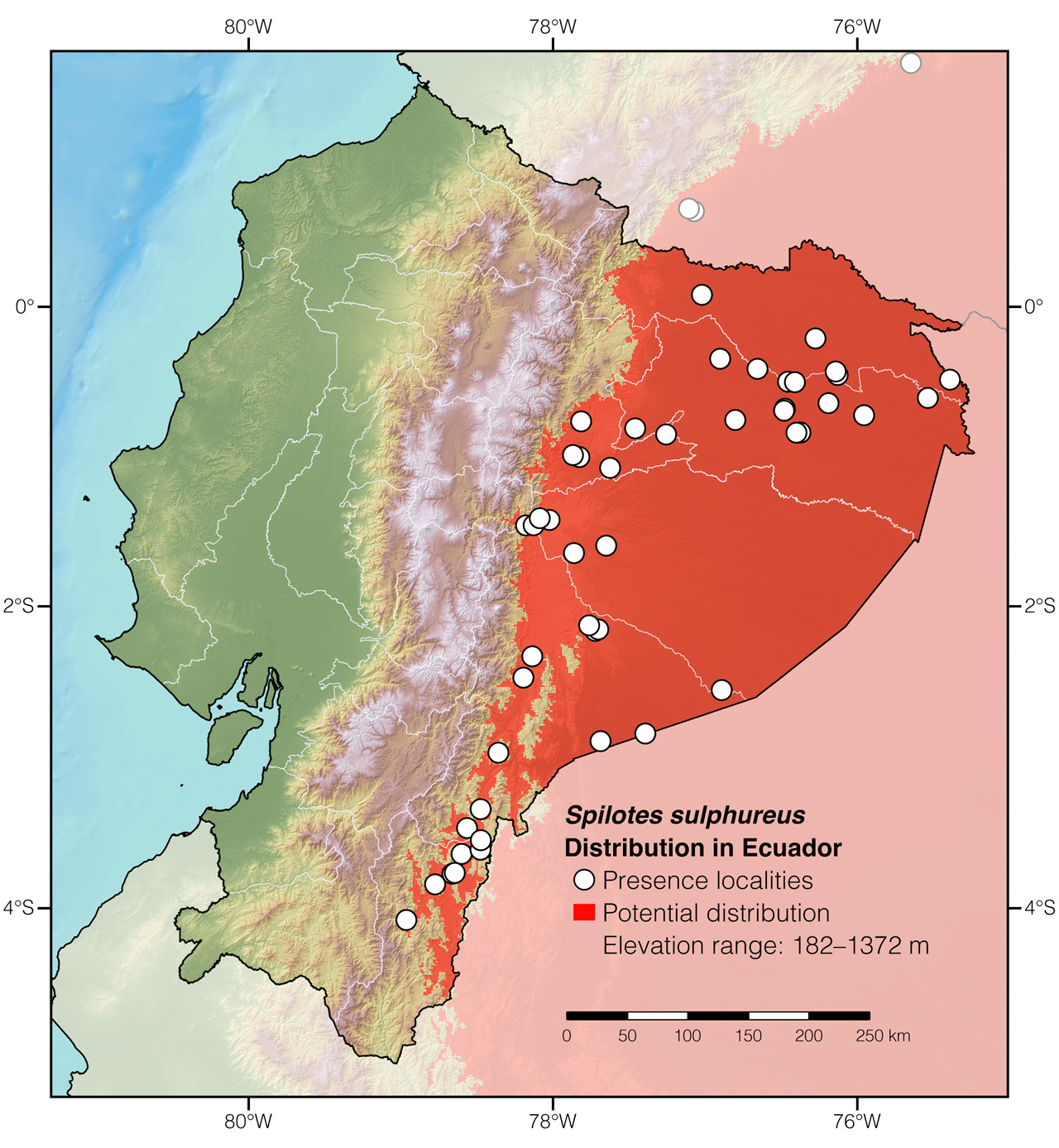
Figure 2: Distribution of Spilotes sulphureus in Ecuador. See Appendix 1 for a complete list of the presence localities included in the map.
Etymology: The generic name Spilotes is a Greek word meaning “stained.”18 The word sulphureus comes from the Latin and means “colored like sulfur.”18
Where to observe: Individuals of Spilotes sulphureus are typically seen at a rate of about once every few years in the Ecuadorian Amazon region. A prime area for this species is the valley of the Río Zamora.
Special thanks to Roy Arthur Blodgett for symbolically adopting the Yellow-bellied Puffing-Snake and helping bring the Reptiles of Ecuador book project to life.
Acknowledgments: Special thanks to Quetzal Dwyer of Reptilandia for providing access to the specimens of Spilotes sulphureus photographed in this account.
Authors: Alejandro ArteagaaAffiliation: Fundación Khamai, Reserva Arlequín, Ecoruta Paseo del Quinde km 56, Santa Rosa de Mindo, Pichincha 171202, Ecuador. and Gabriela AguiarbIndependent researcher, Quito, Ecuador.
Photographer: Jose VieiracAffiliation: Tropical Herping (TH), Quito, Ecuador.,dAffiliation: ExSitu, Quito, Ecuador.
How to cite? Arteaga A, Aguiar G (2026) Yellow-bellied Puffing-Snake (Spilotes sulphureus). In: Arteaga A, Bustamante L, Vieira J (Eds) Reptiles of Ecuador: Life in the middle of the world. Available from: www.reptilesofecuador.com. https://doi.org/10.47051/YXNS3648
Literature cited:
- Field notes, Reptiles of Ecuador book project.
- Valencia JH, Garzon-Tello K (2018) Reproductive behavior and development in Spilotes sulphureus (Serpentes: Colubridae) from Ecuador. Phyllomedusa 17: 113–126. https://doi.org/10.11606/issn.2316-9079.v17i1p113-126
- Duellman WE (1978) The biology of an equatorial herpetofauna in Amazonian Ecuador. Publications of the Museum of Natural History, University of Kansas 65: 1–352.
- Duellman WE (2005) Cusco amazónico: the lives of amphibians and reptiles in an Amazonian rainforest. Cornell University Press, Ithaca, 433 pp.
- Dixon JR, Soini P (1986) The reptiles of the upper Amazon Basin, Iquitos region, Peru. Milwaukee Public Museum, Milwaukee, 154 pp.
- Pérez-Santos C, Moreno AG (1988) Ofidios de Colombia. Museo Regionale di Scienze Naturali, Torino, 517 pp.
- Murphy JC, Downie R, Smith JM, Livingstone S, Mohammed R, Lehtinen RM, Eyre M, Sewlal JN, Noriega N, Casper GS, Anton T, Rutherford MG, Braswell AL, Jowers MJ (2018) A field guide to the amphibians & reptiles of Trinidad and Tobago. Trinidad and Tobago Naturalist’s Club, Port of Spain, 336 pp.
- Natera-Mumaw M, Esqueda-González LF, Castelaín-Fernández M (2015) Atlas serpientes de Venezuela. Dimacofi Negocios Avanzados S.A., Santiago de Chile, 456 pp.
- Boos H (2001) The snakes of Trinidad and Tobago. Texas A&M University Press, College Station, 270 pp.
- Photographic record by Samy Lima
- Cunha OR, Nascimento FP (1993) Ofídios da Amazônia. As cobras da região leste do Pará. Papéis Avulsos Museu Paraense Emílio Goeldi 40: 9–87.
- dos Santos-Costa MC, Maschio GF, da Costa Prudente AL (2015) Natural history of snakes from Floresta Nacional de Caxiuanã, eastern Amazonia, Brazil. Herpetology Notes 8: 69–98.
- Martins M, Oliveira ME (1998) Natural history of snakes in forests of the Manaus region, Central Amazonia, Brazil. Herpetological Natural History 6: 78–150.
- Beebe W (1946) Field notes on the snakes of Kartabo, British Guiana, and Caripito, Venezuela. Zoologica 31: 11–52.
- Guedes TB (2021): A Matryoshka of scales: a single specimen reveals multiple new aspects of diet and distribution of snakes. Herpetology Notes 14: 385–390.
- Gutiérrez-Cárdenas P, Rivas G, Caicedo J, Gagliardi G, Gonzales L, Nogueira C, Murphy J (2019) Spilotes sulphureus. The IUCN Red List of threatened species. Available from: www.iucnredlist.org. https://doi.org/10.2305/IUCN.UK.2019-3.RLTS.T15183770A15183779.en
- Nogueira CC, Argôlo AJS, Arzamendia V, Azevedo JA, Barbo FE, Bérnils RS, Bolochio BE, Borges-Martins M, Brasil-Godinho M, Braz H, Buononato MA, Cisneros-Heredia DF, Colli GR, Costa HC, Franco FL, Giraudo A, Gonzalez RC, Guedes T, Hoogmoed MS, Marques OAV, Montingelli GG, Passos P, Prudente ALC, Rivas GA, Sanchez PM, Serrano FC, Silva NJ, Strüssmann C, Vieira-Alencar JPS, Zaher H, Sawaya RJ, Martins M (2019) Atlas of Brazilian snakes: verified point-locality maps to mitigate the Wallacean shortfall in a megadiverse snake fauna. South American Journal of Herpetology 14: 1–274. https://doi.org/10.2994/SAJH-D-19-00120.1
- Brown RW (1956) Composition of scientific words. Smithsonian Books, Washington D.C., 882 pp.
Appendix 1: Locality data used to create the distribution map of Spilotes sulphureus in Ecuador (Fig. 2).
| Country | Province | Locality | Source |
| Colombia | Caquetá | Florencia | FMNH 165202; VertNet |
| Colombia | Putumayo | Centro Experimental Amazónico | Betancourth-Cundar & Gutiérrez-Zamora 2010 |
| Colombia | Putumayo | Reserva La Isla Escondida | iNaturalist; photo examined |
| Ecuador | Morona Santiago | Bomboiza | Nogueira et al. 2019 |
| Ecuador | Morona Santiago | El Pescado | Pazmiño-Otamendi 2021 |
| Ecuador | Morona Santiago | El Tiink | Nogueira et al. 2019 |
| Ecuador | Morona Santiago | Macas | Online multimedia |
| Ecuador | Morona Santiago | Macuma | iNaturalist; photo examined |
| Ecuador | Morona Santiago | Paantim | Valencia & Garzón-Tello 2018 |
| Ecuador | Morona Santiago | San José de Morona | iNaturalist; photo examined |
| Ecuador | Morona Santiago | Sapapentza | iNaturalist; photo examined |
| Ecuador | Morona Santiago | Sucúa | USNM 283964; VertNet |
| Ecuador | Morona Santiago | Wisui | Chaparro et al. 2011 |
| Ecuador | Napo | Jatun Sacha Biological Station | Hernández-Sánchez 2013 |
| Ecuador | Napo | Osayacu | Arteaga et al. 2013 |
| Ecuador | Napo | Tena | iNaturalist; photo examined |
| Ecuador | Napo | Via Tena–Muyuna | Medrano-Vizcaíno et al. 2023 |
| Ecuador | Napo | Yachana Reserve | Whitworth & Beirne 2011 |
| Ecuador | Orellana | Bosque Protector del INIAP | Pazmiño-Otamendi 2021 |
| Ecuador | Orellana | Comunidad Kichwa Añangu | Nogueira et al. 2019 |
| Ecuador | Orellana | Cotapino | Nogueira et al. 2019 |
| Ecuador | Orellana | Paso Tiputini Sur | iNaturalist; photo examined |
| Ecuador | Orellana | Pompeya–Iro km 76 | Nogueira et al. 2019 |
| Ecuador | Orellana | Pozo Pindo-1 | Nogueira et al. 2019 |
| Ecuador | Orellana | Río Bigal | Photo by Thierry García |
| Ecuador | Orellana | Rumi Yaku | iNaturalist; photo examined |
| Ecuador | Orellana | Tiputini Biodiversity Station | Cisneros-Heredia 2003 |
| Ecuador | Orellana | Vía Pompeya Sur–Iro, km 34 | Photo by Neshat Shogui |
| Ecuador | Orellana | Vía Pompeya Sur–Iro, km 43 | Nogueira et al. 2019 |
| Ecuador | Orellana | Vía Pompeya Sur–Iro, km 72 | Nogueira et al. 2019 |
| Ecuador | Pastaza | Abitagua | UMMZ 88946; VertNet |
| Ecuador | Pastaza | Centro Fátima | Nogueira et al. 2019 |
| Ecuador | Pastaza | Kapawi Reserve | iNaturalist; photo examined |
| Ecuador | Pastaza | Mangayacu | iNaturalist; photo examined |
| Ecuador | Pastaza | Puyo, 27 km SE of | Nogueira et al. 2019 |
| Ecuador | Pastaza | Río Chambira | Nogueira et al. 2019 |
| Ecuador | Pastaza | Sumak Kawsay In Situ | Bentley et al. 2021 |
| Ecuador | Sucumbios | Pañacocha | iNaturalist; photo examined |
| Ecuador | Sucumbíos | Garzacocha | iNaturalist; photo examined |
| Ecuador | Sucumbíos | La Selva Lodge | Nogueira et al. 2019 |
| Ecuador | Sucumbíos | Limoncocha | KU 105426; VertNet |
| Ecuador | Sucumbíos | Santa Cecilia | Duellman 1978 |
| Ecuador | Sucumbíos | Tipishca | Valencia & Garzón-Tello 2018 |
| Ecuador | Sucumbíos | Zancudococha | Nogueira et al. 2019 |
| Ecuador | Zamora Chinchipe | El Pangui | Darwin Núñez, pers. comm. |
| Ecuador | Zamora Chinchipe | Los Encuentros | iNaturalist; photo examined |
| Ecuador | Zamora Chinchipe | Perma Tree | Photo by Yago Veith |
| Ecuador | Zamora Chinchipe | Subcuenca del Río Tundayme | Betancourt et al. 2018 |
| Ecuador | Zamora Chinchipe | Valle del Quimi | Betancourt et al. 2018 |
| Ecuador | Zamora Chinchipe | Yantzaza | iNaturalist; photo examined |
| Ecuador | Zamora Chinchipe | Zamora | Darwin Núñez, pers. comm. |
| Perú | Amazonas | Yutupis | USNM 566607; VertNet |