


Published June 10, 2026. Updated September 6, 2026. Open access. | Purchase book ❯ |
Tarletons’ Lightbulb-Lizard (Riama tarletonorum)
Reptiles of Ecuador | Sauria | Gymnophthalmidae | Riama tarletonorum
English common name: Tarletons’ Lightbulb-Lizard.
Spanish common name: Lagartija minadora de los Tarleton.
Recognition: ♂♂ 17.7 cmMaximum distance from the snout to the tip of the tail. Snout–vent length=9.0 cm. ♀♀ 17.3 cmMaximum distance from the snout to the tip of the tail. Snout–vent length=8.1 cm..1 Lightbulb-lizards (Riama) are easily distinguished from other sympatric lizards by their fossorial habits and extremely reduced extremities, where the fore- and hind limbs are too short to meet when adpressed against the body.2,3 The Tarletons’ Lightbulb-Lizard (R. tarletonorum) is the sole representative of its genus within its known geographic range and is readily recognized by its stocky body and uniformly colored dorsum with ocelli along the flanks (Fig. 1).1 This species differs from R. unicolor by lacking subcaudal stripes.1 From R. simotera, it differs by having an incomplete series of superciliary scales. From the similar, but allopatric R. colomaromani, it differs by having fewer longitudinal dorsal scale rows in males (21–25 vs. 24–27) and a completely different dorsal coloration in females, consisting of a drab background with fine reddish and black speckling and flanks bearing distinct ocelli.1 Riama tarletonorum displays pronounced sexual dimorphism, with males differing from females by their larger size, broader heads, and glossy black coloration.1
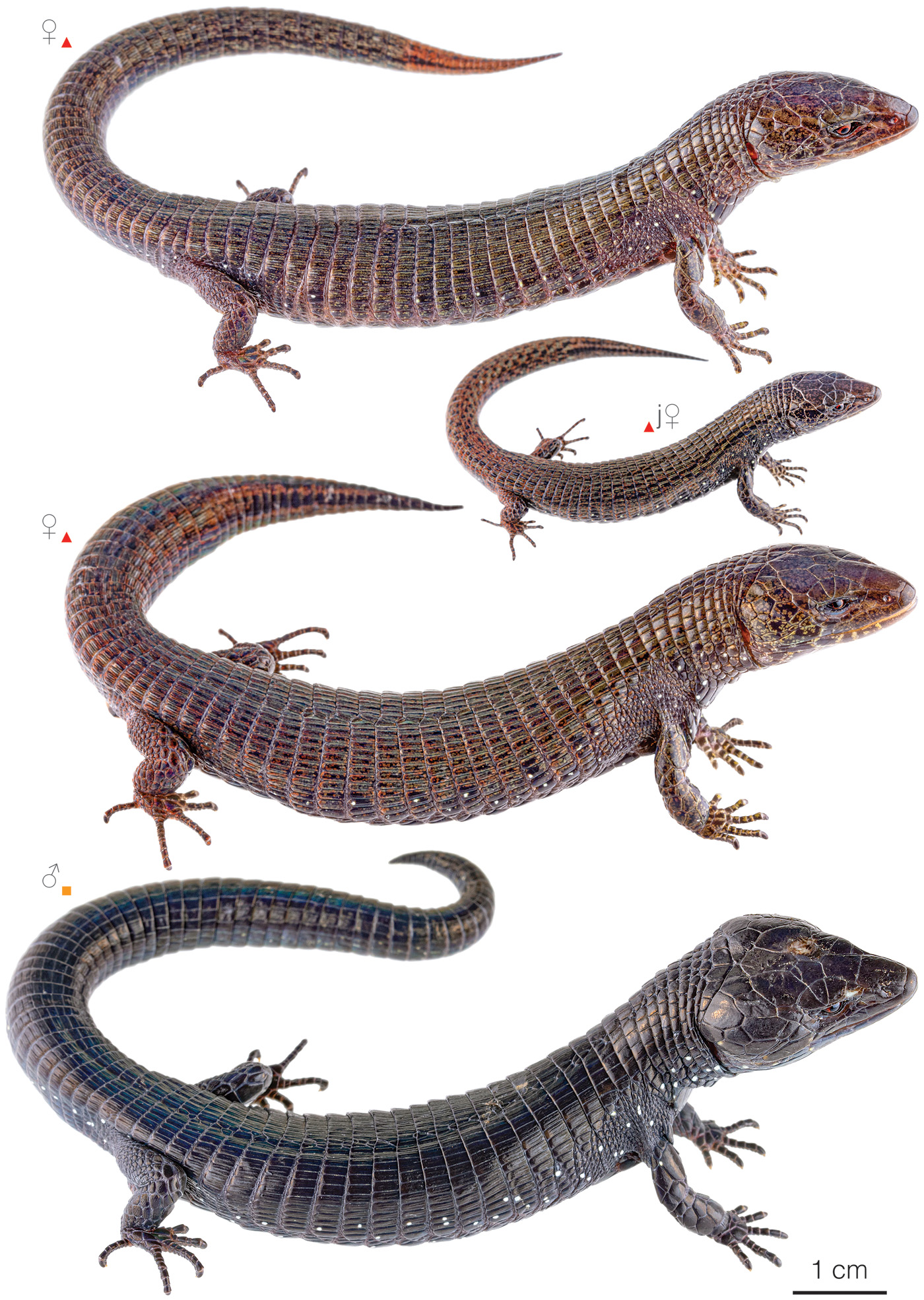
Figure 1: Individuals of Riama tarletonorum from Carchi province, Ecuador: El Morán (); La Centella (). j=juvenile.
Natural history: Riama tarletonorum is a rarely encountered lizard that, so far, has only been recorded in agricultural mosaic environment consisting of pastures, crops, living fences, and remnants of high evergreen montane forest.1 This species exhibits semi-fossorial habits, routinely found sheltered beneath rocks, buried under soft dark soil, or in dirt walls among roots and rotten logs.1 When exposed, individuals rapidly attempt to retreat underground; if captured, they may bite or employ caudal autotomy to shed the tail. Like its congeners, Tarletons’ Lightbulb-Lizards exhibit extreme stenothermy, rapidly succumbing to elevated temperatures if exposed to direct sunlight or handled continuously for more than a few seconds.4
By purchasing the hardcover or PDF of the Reptiles of Ecuador, you help keep this website 100% free.
Conservation: Data Deficient There is inadequate information to make an assessment of extinction risk..1 Riama tarletonorum is recommended for this category because the species belongs to a poorly studied genus of lizards and is known only from three localities along a single river valley (Río La Plata). At one of the localities, El Morán, the majority of the native cloud forest habitat has been converted to pastures. Thus, there is insufficient data to estimate whether this new lizard species is restricted to an area no greater than 20 km2 or if it ranges into neighboring Colombia.
Distribution: Riama tarletonorum is known only from three localities on the upper watershed of the Río La Plata in Carchi province on the western slopes of the northern Ecuadorian Andes. The species occurs over an area of approximately 20 km2 (Fig. 2).
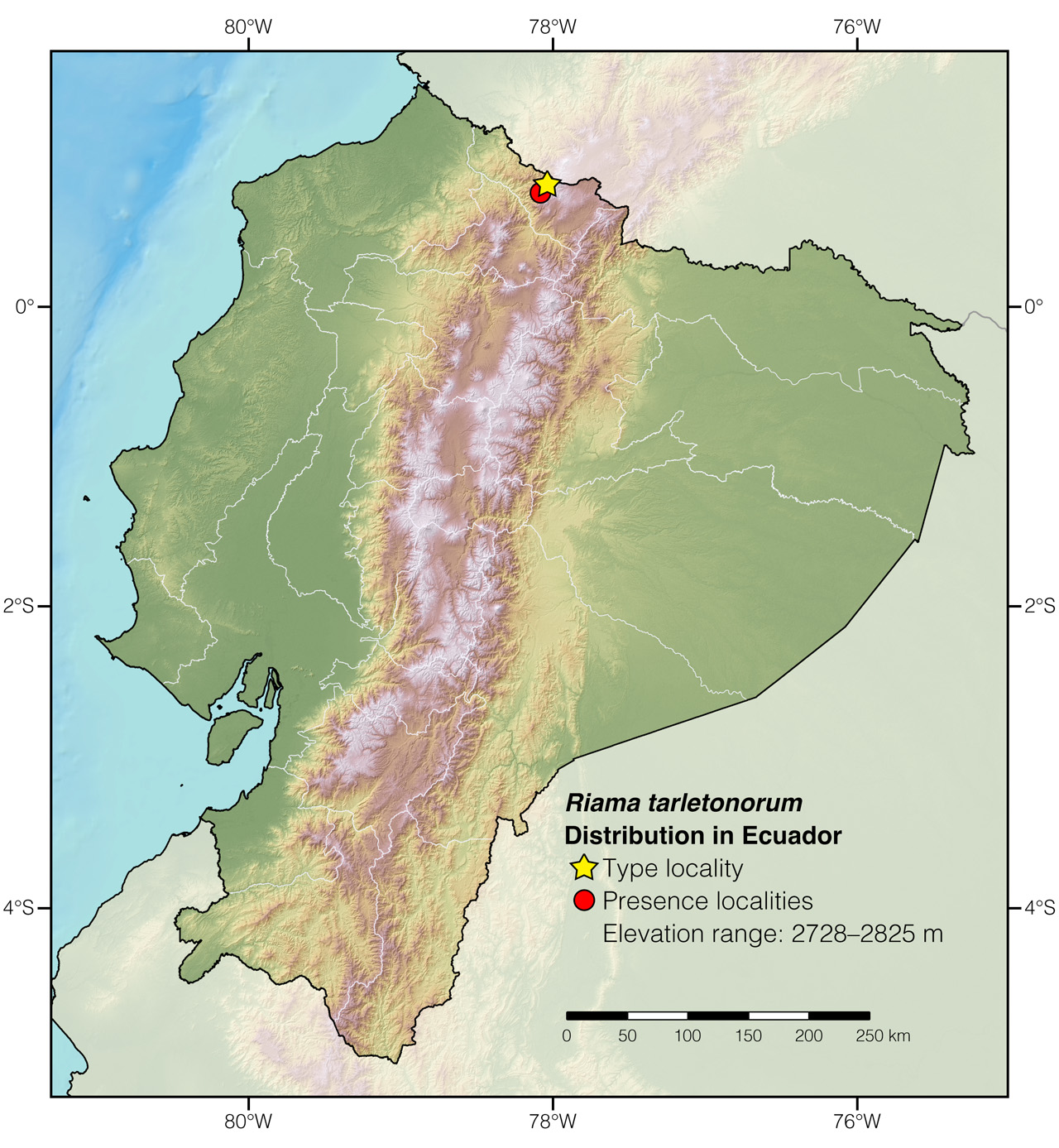
Figure 2: Distribution of Riama tarletonorum in Ecuador. The star corresponds to the type locality: La Centella, Carchi province. See Appendix 1 for a complete list of the presence localities included in the map.
Etymology: The generic name Riama does not appear to be a reference to any feature of this group of lizards, but a matter of personal taste. John Edward Gray usually selected girls’ names to use on reptiles.5–8 The species is named after the Tarleton family of Austin, Texas (Stephen, Marissa, Owen, and Charlotte), all passionate about travel, nature, and conservation. The Tarletons helped fund the expedition that resulted in the discovery of this new species of burrowing lizard.1
Where to observe: Riama tarletonorum is rarely recorded unless researchers actively sample suitable microhabitats by methodically digging into loose organic topsoil or overturning large rocks and decaying logs. However, in localized microhabitats featuring adequate moisture and native forest cover, population densities can be surprisingly high. Targeted sampling yields predictable encounter rates of approximately 3–6 individuals per day of field effort, with optimal search sites including La Centella and El Morán.
Author: Alejandro ArteagaaAffiliation: Fundación Khamai, Reserva Arlequín, Ecoruta Paseo del Quinde km 56, Santa Rosa de Mindo, Pichincha 171202, Ecuador.
Photographer: Jose VieirabAffiliation: Tropical Herping (TH), Quito, Ecuador.,cAffiliation: ExSitu, Quito, Ecuador.
How to cite? Arteaga A (2026) Tarletons’ Lightbulb-Lizard (Riama tarletonorum). In: Arteaga A, Bustamante L, Vieira J (Eds) Reptiles of Ecuador: Life in the middle of the world. Available from: www.reptilesofecuador.com. https://doi.org/10.47051/VPKE5287
Literature cited:
- Arteaga A, Tovar-Ortiz A, Vieira J, Bringsøe H, Quezada A, Camper J, Harris K (2026) Six new species of lizards (Riama, Sauria, Gymnophthalmidae) from the high Andes of Ecuador. In: Arteaga A, Bustamante L, Vieira J (Eds) Reptiles of Ecuador. Second Edition. Khamai Foundation & Tropical Herping, Quito, 1082–1119. https://doi.org/10.47051/GZNM5526
- Doan TM, Castoe TA (2005) Phylogenetic taxonomy of the Cercosaurini (Squamata: Gymnophthalmidae), with new genera for species of Neusticurus and Proctoporus. Zoological Journal of the Linnean Society 143: 405–416. https://doi.org/10.1111/j.1096-3642.2005.00145.x
- Kizirian DA (1996) A review of Ecuadorian Proctoporus (Squamata: Gymnophthalmidae) with descriptions of nine new species. Herpetological Monographs 10: 85–155. https://doi.org/10.2307/1466981
- Field notes, Reptiles of Ecuador book project.
- Gray JE (1831) Description of a new genus of ophisaurean animal, discovered by the late James Hunter in New Holland. Treuttel, Würtz & Co., London, 40 pp.
- Gray JE (1831) A synopsis of the species of the class Reptilia. In: Griffith E, Pidgeon E (Eds) The animal kingdom arranged in conformity with its organization. Whittaker, Treacher, & Co., London, 1–110.
- Gray JE (1838) Catalogue of the slender-tongued saurians, with descriptions of many new genera and species. Annals and Magazine of Natural History 1: 274–283.
- Gray JE (1845) Catalogue of the specimens of lizards in the collection of the British Museum. Trustees of the British Museum, London, 289 pp.
Appendix 1: Locality data used to create the distribution map of Riama tarletonorum in Ecuador (Fig. 2). Asterisk (*) indicates type locality.
| Country | Province | Locality | Source |
| Ecuador | Carchi | El Morán | Arteaga et al. 2026 |
| Ecuador | Carchi | La Centella* | Arteaga et al. 2026 |
| Ecuador | Carchi | Maldonado, 26.9–27.3 km W of | Sánchez-Pacheco et al. 2012 |