


Published June 10, 2026. Updated August 25, 2026. Open access. | Purchase book ❯ |
Higgins’ Lightbulb-Lizard (Riama higginsi)
Reptiles of Ecuador | Sauria | Gymnophthalmidae | Riama higginsi
English common name: Higgins’ Lightbulb-Lizard.
Spanish common name: Lagartija minadora de Higgins.
Recognition: ♂♂ 15.7 cmMaximum distance from the snout to the tip of the tail. Snout–vent length=5.5 cm. ♀♀ 13.7 cmMaximum distance from the snout to the tip of the tail. Snout–vent length=5.3 cm..1 Lightbulb-lizards (Riama) are easily distinguished from other sympatric lizards by their fossorial habits and extremely reduced extremities, where the fore- and hind limbs are too short to meet when adpressed against the body.2,3 The Higgins’ Lightbulb-Lizard (R. higginsi) differs from other members of its genus by having a brown dorsum with scattered irregular black spots and a black-bordered ochraceous dorsolateral stripe running from the neck to the first third of the body (Fig. 1).1 This species differs from the potentially sympatric R. colomaromani by being smaller in body size and lacking the glossy black dorsal coloration typical of the latter. From R. labionis and R. yumborum, R. higginsi differs by having a uniformly black belly. From R. unicolor, it differs by being smaller and having no clearly defined black stripes on the tail underside. Riama higginsi exhibits little sexual dimorphism, with males differing from females primarily by having a reddish tint on the lower flanks and sides of tail.1
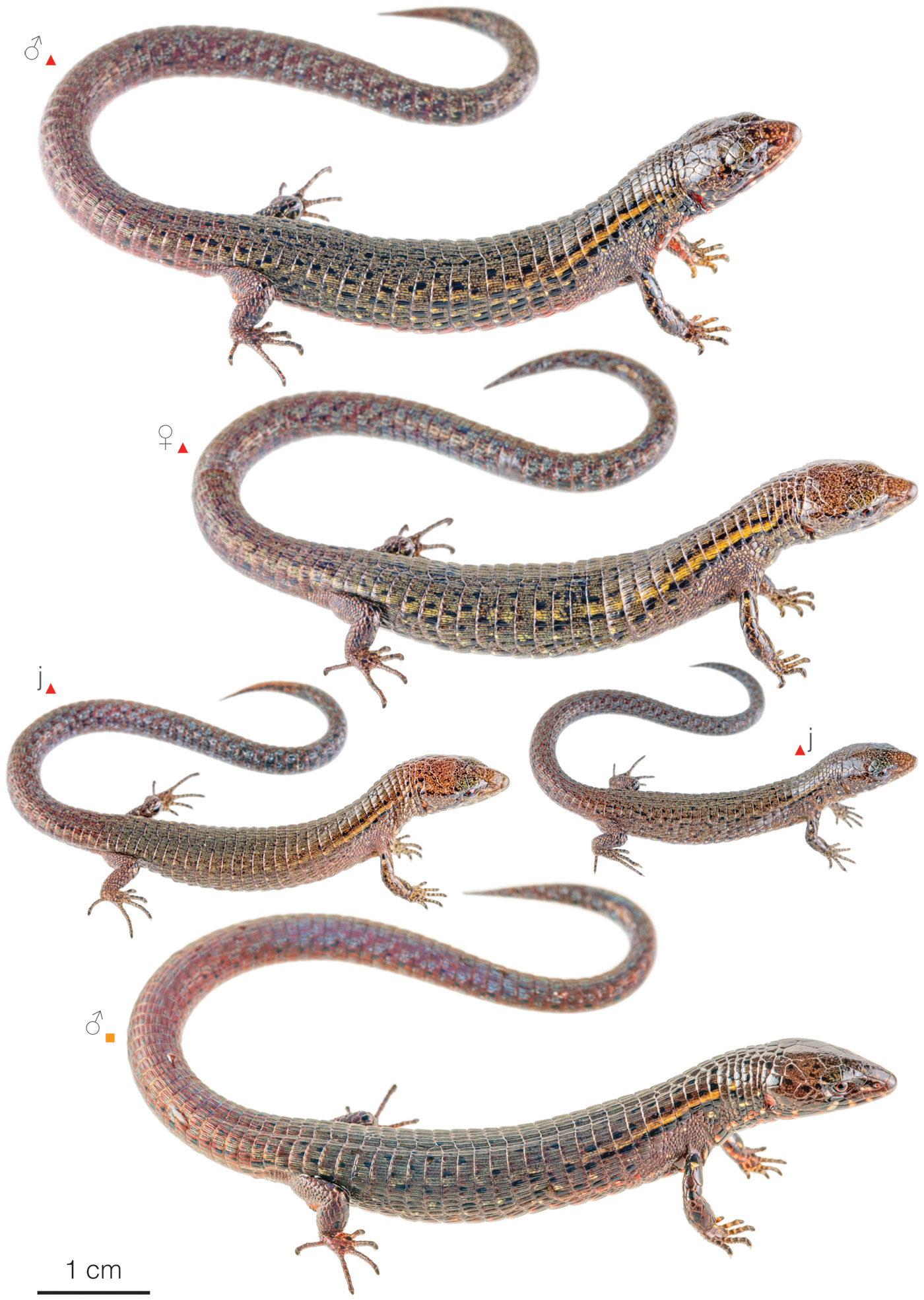
Figure 1: Individuals of Riama higginsi from Pichincha province, Ecuador: Chillogallo–Guajalito road (); Arlequín Reserve (). j=juvenile.
Natural history: Riama higginsi is a rarely encountered, semi-fossorial lizard that occurs in pristine montane cloud forests as well as along forest-edge clearings and dirt roads.1 Higgins’ Lightbulb-Lizards spend the vast majority of their lives within crevices, self-excavated tunnel networks in friable soils, or concealed beneath rocks, decomposing logs, root systems, and deep leaf-litter matrices.1,4 Nevertheless, both diurnal and nocturnal surface activity over the leaf-litter, on rocky walls, or along dirt roads is occasionally observed.5 Uniquely for the genus, this species displays a strong affinity for vertical substrate, attaining high local densities on moss-covered cliffs along river corridors, rocky faces adjacent to waterfalls, and mossy tree trunks up to 4 m above the ground.1,5 Reproduction is oviparous; fixed clutches of two eggs have been recovered nestled directly within the moss mats covering these vertical microhabitats. Documented natural predators include the colubrid snake Saphenophis boursieri.6 When unearthed or exposed, individuals rapidly attempt to retreat underground; if handled, they may bite or employ caudal autotomy to shed the tail.5 Like its congeners, R. higginsi exhibits extreme stenothermy, rendering it exceptionally vulnerable to thermal stress—rapidly succumbing to elevated temperatures if exposed to direct sunlight or handled continuously for more than a few seconds.4,5
By purchasing the hardcover or PDF of the Reptiles of Ecuador, you help keep this website 100% free.
Conservation: Near Threatened Not currently at risk of extinction, but requires some level of management to maintain healthy populations..1 Riama higginsi is recommended for this category because, despite having a restricted geographic range and vulnerability to habitat degradation, it is currently known from more than 10 localities and spans a region that retains a substantial proportion of its original montane cloud forest cover.1 Furthermore, over half of its recorded localities fall within privately protected nature reserves. Consequently, the species is not currently considered to face an immediate risk of extinction, though continuous monitoring remains essential given ongoing regional deforestation pressures.
Distribution: Riama higginsi is endemic to an area of approximately 1,731 km2 along the Pacific slopes of the Andes in northern Ecuador (Fig. 2).
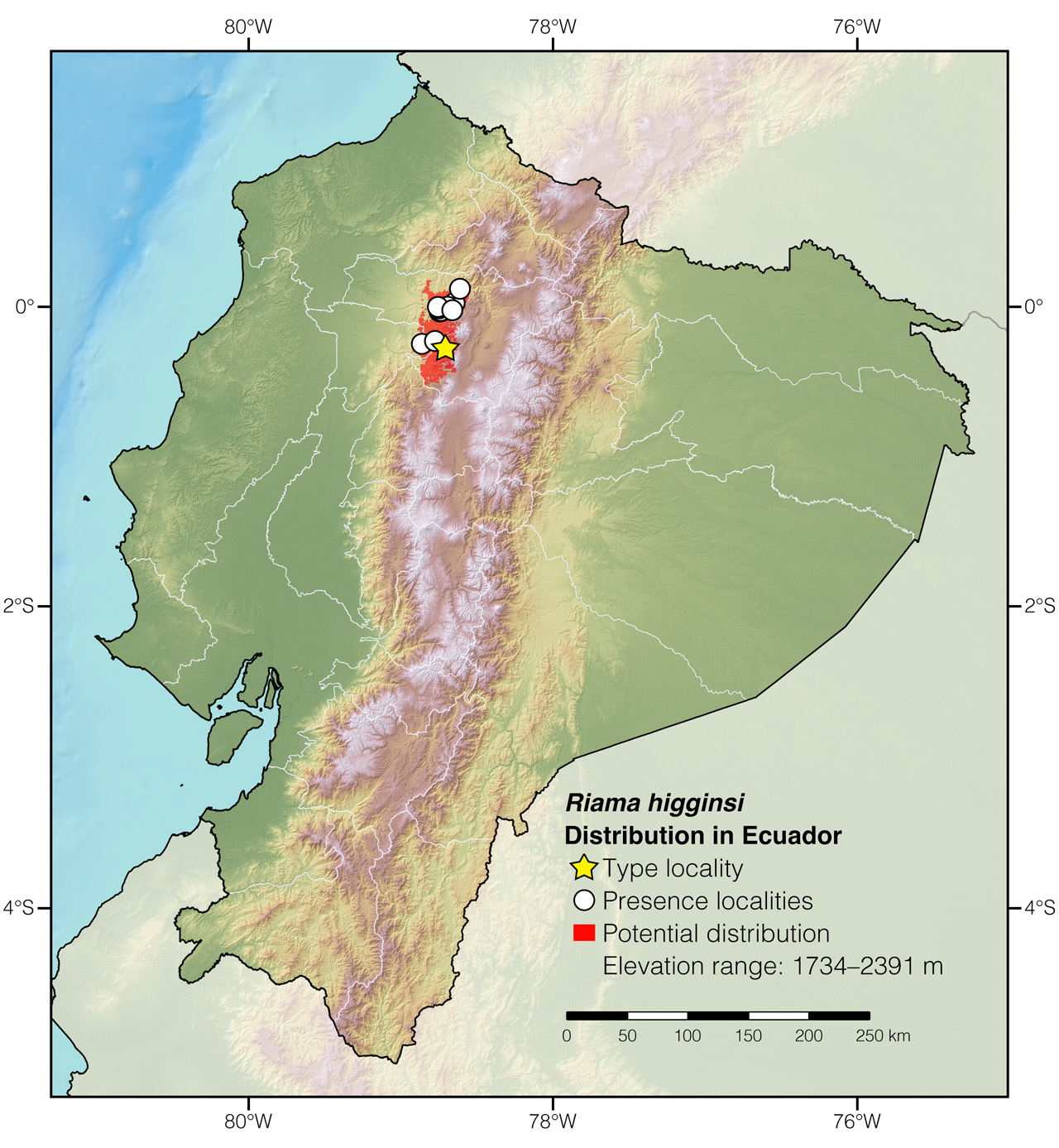
Figure 2: Distribution of Riama higginsi in Ecuador. The star corresponds to the type locality: Chillogallo–Guajalito road, Pichincha province. See Appendix 1 for a complete list of the presence localities included in the map.
Etymology: The generic name Riama does not appear to be a reference to any feature of this group of lizards, but a matter of personal taste. John Edward Gray usually selected girls’ names to use on reptiles.7–10 The species is named after Joseph Higgins, whose dedication to the preservation of tropical biodiversity is exemplary. Higgins’ support of the Khamai Foundation has helped this young organization protect 342 hectares of cloud forest and rainforest ecosystems in Ecuador, including key habitat for the survival of R. higginsi.1
Where to observe: Riama higginsi is rarely encountered unless researchers actively target its microhabitat by methodically digging in areas of friable soil or by searching under the moss of cliffs and rocky walls. However, in specific optimal localities, population densities can be surprisingly high. Within the Arlequín Reserve, intensive sampling efforts yield a predictable encounter rate of approximately 2–3 individuals per day of dedicated fieldwork.
Author: Alejandro ArteagaaAffiliation: Fundación Khamai, Reserva Arlequín, Ecoruta Paseo del Quinde km 56, Santa Rosa de Mindo, Pichincha 171202, Ecuador.
Photographer: Jose VieirabAffiliation: Tropical Herping (TH), Quito, Ecuador.,cAffiliation: ExSitu, Quito, Ecuador.
How to cite? Arteaga A (2026) Higgins’ Lightbulb-Lizard (Riama higginsi). In: Arteaga A, Bustamante L, Vieira J (Eds) Reptiles of Ecuador: Life in the middle of the world. Available from: www.reptilesofecuador.com. https://doi.org/10.47051/NTSO2974
Literature cited:
- Arteaga A, Tovar-Ortiz A, Vieira J, Bringsøe H, Quezada A, Camper J, Harris K (2026) Six new species of lizards (Riama, Sauria, Gymnophthalmidae) from the high Andes of Ecuador. In: Arteaga A, Bustamante L, Vieira J (Eds) Reptiles of Ecuador. Second Edition. Khamai Foundation & Tropical Herping, Quito, 1082–1119. https://doi.org/10.47051/GZNM5526
- Doan TM, Castoe TA (2005) Phylogenetic taxonomy of the Cercosaurini (Squamata: Gymnophthalmidae), with new genera for species of Neusticurus and Proctoporus. Zoological Journal of the Linnean Society 143: 405–416. https://doi.org/10.1111/j.1096-3642.2005.00145.x
- Kizirian DA (1996) A review of Ecuadorian Proctoporus (Squamata: Gymnophthalmidae) with descriptions of nine new species. Herpetological Monographs 10: 85–155. https://doi.org/10.2307/1466981
- Savit AZ (2006) Reptiles of the Santa Lucía Cloud Forest, Ecuador. Iguana 13: 94–103.
- Field notes, Reptiles of Ecuador book project.
- Cisneros-Heredia DF (2005) Saphenophis boursieri. Habitat, reproduction and diet. Herpetological Review 36: 71.
- Gray JE (1831) Description of a new genus of ophisaurean animal, discovered by the late James Hunter in New Holland. Treuttel, Würtz & Co., London, 40 pp.
- Gray JE (1831) A synopsis of the species of the class Reptilia. In: Griffith E, Pidgeon E (Eds) The animal kingdom arranged in conformity with its organization. Whittaker, Treacher, & Co., London, 1–110.
- Gray JE (1838) Catalogue of the slender-tongued saurians, with descriptions of many new genera and species. Annals and Magazine of Natural History 1: 274–283.
- Gray JE (1845) Catalogue of the specimens of lizards in the collection of the British Museum. Trustees of the British Museum, London, 289 pp.
Appendix 1: Locality data used to create the distribution map of Riama higginsi in Ecuador (Fig. 2). Asterisk (*) indicates type locality.
| Country | Province | Locality | Source |
| Ecuador | Pichincha | Bellavista Lodge | iNaturalist; photo examined |
| Ecuador | Pichincha | Birdwatcher’s House | Arteaga et al. 2026 |
| Ecuador | Pichincha | Chillogallo, 23 km W of* | Arteaga et al. 2026 |
| Ecuador | Pichincha | House of Gary Schilz | Arteaga et al. 2026 |
| Ecuador | Pichincha | Reserva Arlequín | Arteaga et al. 2026 |
| Ecuador | Pichincha | Reserva El Pahuma | Arteaga et al. 2026 |
| Ecuador | Pichincha | Reserva Las Gralarias | Arteaga et al. 2013 |
| Ecuador | Pichincha | Santa Lucía Reserve | Maddock et al. 2011 |
| Ecuador | Pichincha | Santa Rosa de Mindo | Arteaga et al. 2013 |
| Ecuador | Pichincha | Tandayapa | Torres-Carvajal et al. 2019 |
| Ecuador | Pichincha | Tandayapa, 9 km SW of | Kizirian 1996 |
| Ecuador | Pichincha | Vicinities of Chiquilpe | Valencia & Garzón 2011 |
| Ecuador | Santo Domingo de los Tsáchilas | Bosque Protector Río Guajalito | Reyes 2008 |
| Ecuador | Santo Domingo de los Tsáchilas | Granja Experimental La Favorita | Reyes-Puig et al. 2015 |
| Ecuador | Santo Domingo de los Tsáchilas | Las Palmeras | Kizirian 1996 |