


Published June 10, 2026. Updated August 24, 2026. Open access. | Purchase book ❯ |
Sabin’s Lightbulb-Lizard (Riama ellasabinae)
Reptiles of Ecuador | Sauria | Gymnophthalmidae | Riama ellasabinae
English common name: Sabin’s Lightbulb-Lizard.
Spanish common name: Lagartija minadora de Sabin.
Recognition: ♂♂ 14 cmMaximum distance from the snout to the tip of the tail. Snout–vent length=4.2 cm. ♀♀ 13 cmMaximum distance from the snout to the tip of the tail. Snout–vent length=5.6 cm..1 Lightbulb-lizards (Riama) are easily distinguished from other sympatric lizards by their fossorial habits and extremely reduced extremities, where the fore- and hind limbs are too short to meet when adpressed against the body.2,3 The Sabin’s Lightbulb-Lizard (R. ellasabinae) may overlap geographically with R. balneator, from which it differs by having a loreal scale, and R. stigmatoral, from which it differs by having reddish (as opposed to black) ventral surfaces. Riama ellasabinae resembles R. anatoloros in size, coloration, and lepidosis, but it differs from this allopatric species by having a loreal scale and lacking distinct dorsolateral stripes.1 Adult males of R. ellasabinae exhibit sexual dimorphism, differing from females by their larger overall size, broader heads, and typically a vibrant red coloration on the lower flanks (Fig. 1) and ventral surfaces.
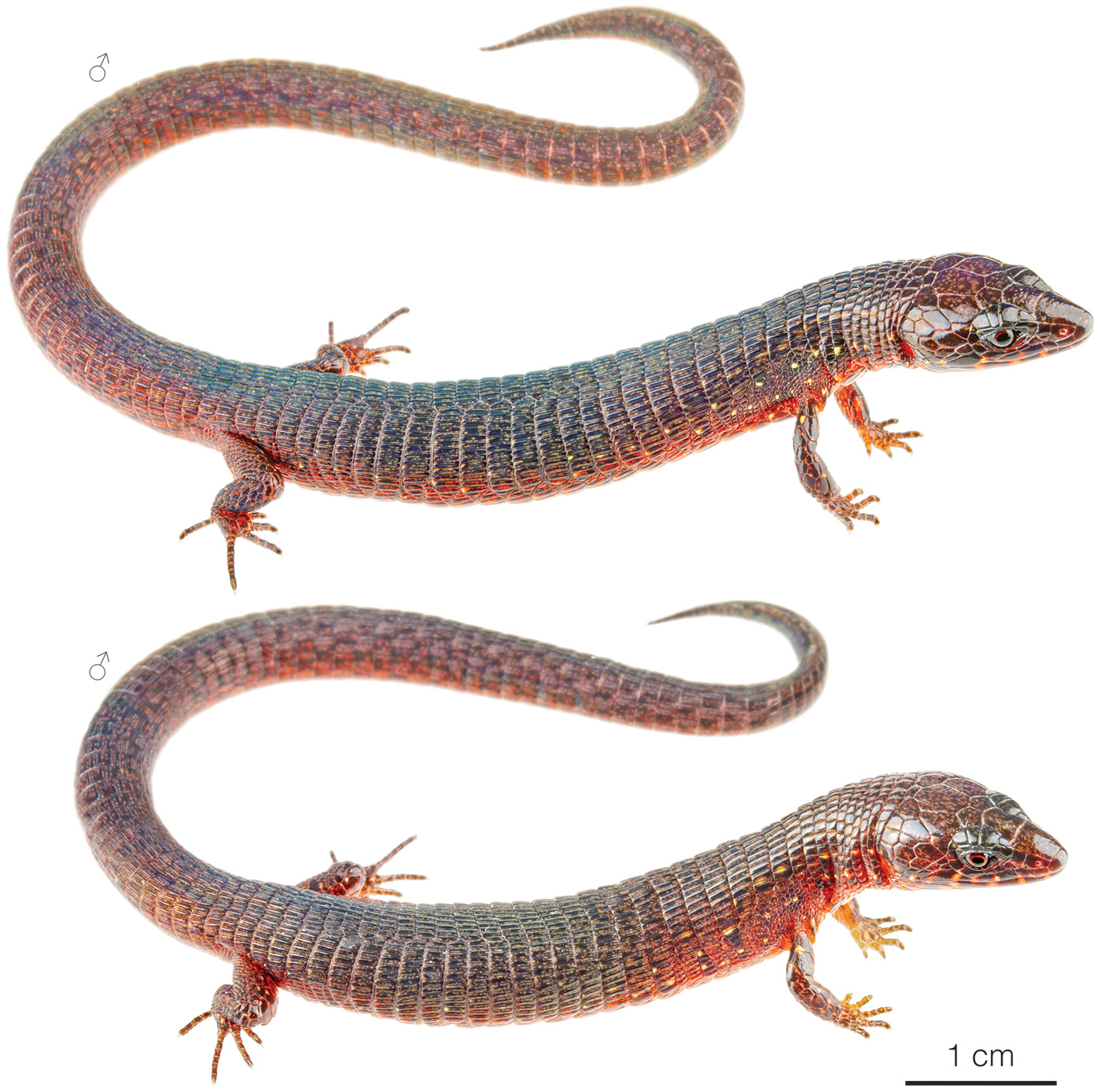
Figure 1: Individuals of Riama ellasabinae from Sendero Sardinayacu, Morona Santiago province, Ecuador.
Natural history: Riama ellasabinae is a rarely encountered, semi-fossorial lizard that primarily inhabits pristine to moderately disturbed cloud forests and lower evergreen montane forests.1 It also persists within mosaic landscapes composed of pastures, rural homesteads, and fragmented remnants of native vegetation. These lizards spend the vast majority of their lives within self-excavated tunnel networks in friable soils or concealed beneath rocks, decomposing logs, and deep leaf-litter matrices,1 though diurnal surface activity is occasionally observed.4 Reproduction is presumed to be oviparous, but clutch sizes have not yet been reported. When unearthed or otherwise exposed, individuals rapidly retreat underground; if captured, they may attempt to bite or will readily employ caudal autotomy to shed the tail. Lightbulb lizards in general exhibit extreme stenothermy and are highly susceptible to thermal stress, rapidly succumbing to elevated temperatures if exposed to direct sunlight or even if handled continuously for more than a few seconds.
By purchasing the hardcover or PDF of the Reptiles of Ecuador, you help keep this website 100% free.
Conservation: Least Concern Believed to be safe from extinction given current circumstances..1 Riama ellasabinae is recommended for listing to this category because the species is distributed over a comparatively wide region (greater than 10,000 km2) of the Amazonian slopes of the Andes that holds large areas of continuous unspoiled forest. It is estimated,1 that approximately 81% of the species’ forest habitat is still standing. Riama ellasabinae occurs in four major protected areas in Ecuador (Llanganates National Park, Sangay National Park, Podocarpus National Park, and Alto Nangaritza Protected Forest). However, habitat destruction from mining and agricultural expansion remains a long-term threat for the majority of the populations.
Distribution: Riama ellasabinae is endemic to an area of approximately 13,131 km2 along the Amazonian slopes of the Andes in central and southern Ecuador (Fig. 2).
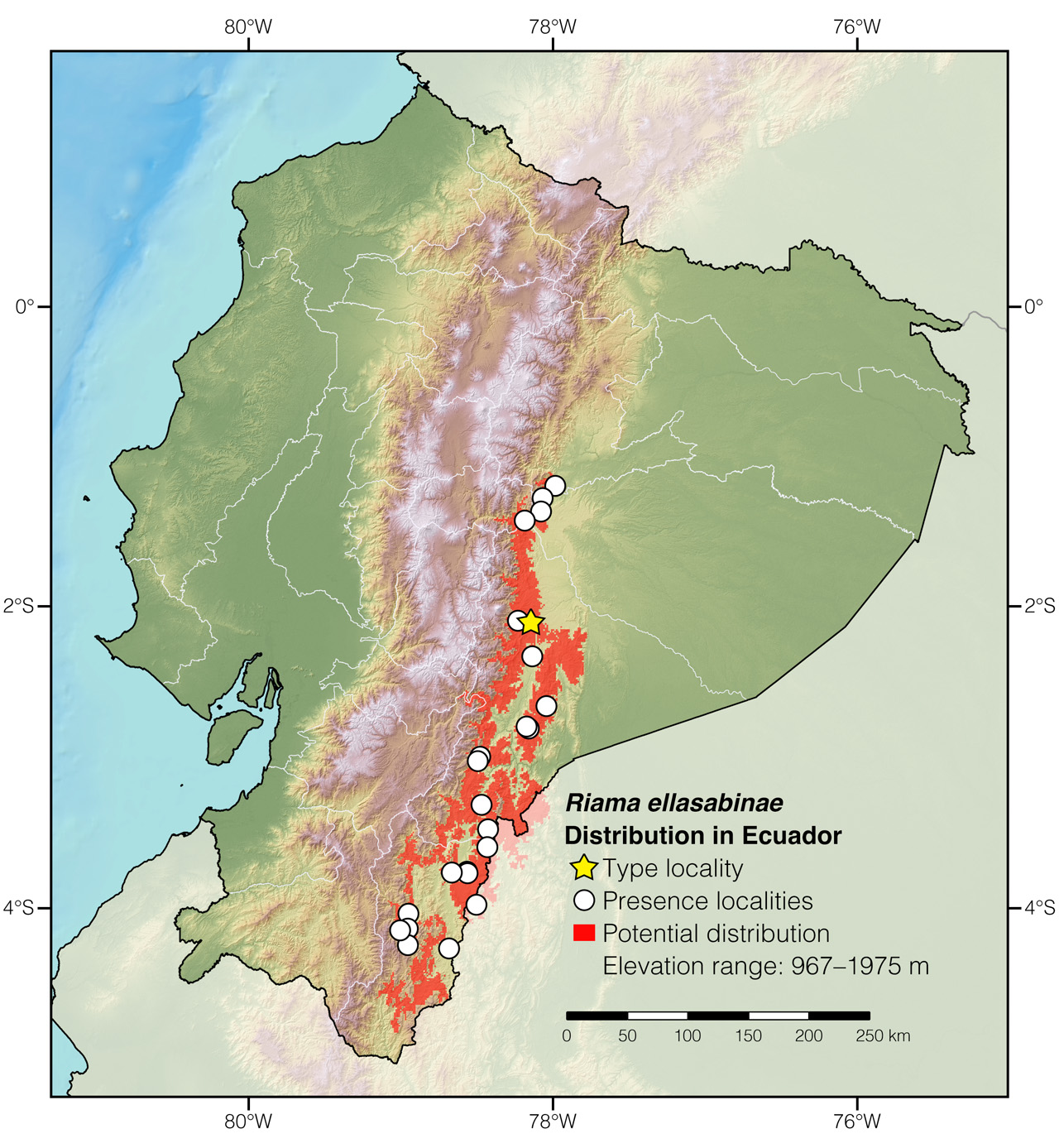
Figure 2: Distribution of Riama ellasabinae in Ecuador. The star corresponds to the type locality: Sendero Sardinayacu, Morona Santiago province. See Appendix 1 for a complete list of the presence localities included in the map.
Etymology: The generic name Riama does not appear to be a reference to any feature of this group of lizards, but a matter of personal taste. John Edward Gray usually selected girls’ names to use on reptiles.8–11 The species is named after Ella Sabin, granddaughter of American philanthropist Andrew Sabin. The Sabin family supports conservation and field research of reptiles and has protected over 264,365 acres of critical habitat throughout the world.1
Where to observe: Riama ellasabinae is rarely encountered unless researchers actively target its microhabitat by methodically raking deep leaf-litter matrices or overturning decaying logs within well-preserved forest tracts. However, in specific optimal localities, population densities can be surprisingly high. Within the Reserva Privada Ankaku and along the trail to the Sardinayacu Lagoon, intensive sampling efforts yield a predictable encounter rate of approximately 2–5 individuals per day of dedicated fieldwork.
Author: Alejandro ArteagaaAffiliation: Fundación Khamai, Reserva Arlequín, Ecoruta Paseo del Quinde km 56, Santa Rosa de Mindo, Pichincha 171202, Ecuador.
Photographer: Alejandro ArteagaaAffiliation: Fundación Khamai, Reserva Arlequín, Ecoruta Paseo del Quinde km 56, Santa Rosa de Mindo, Pichincha 171202, Ecuador.
How to cite? Arteaga A (2026) Sabin’s Lightbulb-Lizard (Riama ellasabinae). In: Arteaga A, Bustamante L, Vieira J (Eds) Reptiles of Ecuador: Life in the middle of the world. Available from: www.reptilesofecuador.com. https://doi.org/10.47051/DSDQ5573
Literature cited:
- Arteaga A, Tovar-Ortiz A, Vieira J, Bringsøe H, Quezada A, Camper J, Harris K (2026) Six new species of lizards (Riama, Sauria, Gymnophthalmidae) from the high Andes of Ecuador. In: Arteaga A, Bustamante L, Vieira J (Eds) Reptiles of Ecuador. Second Edition. Khamai Foundation & Tropical Herping, Quito, 1082–1119. https://doi.org/10.47051/GZNM5526
- Doan TM, Castoe TA (2005) Phylogenetic taxonomy of the Cercosaurini (Squamata: Gymnophthalmidae), with new genera for species of Neusticurus and Proctoporus. Zoological Journal of the Linnean Society 143: 405–416. https://doi.org/10.1111/j.1096-3642.2005.00145.x
- Kizirian DA (1996) A review of Ecuadorian Proctoporus (Squamata: Gymnophthalmidae) with descriptions of nine new species. Herpetological Monographs 10: 85–155. https://doi.org/10.2307/1466981
- Photographic record by Beto Rivadeneira.
- Gray JE (1831) Description of a new genus of ophisaurean animal, discovered by the late James Hunter in New Holland. Treuttel, Würtz & Co., London, 40 pp.
- Gray JE (1831) A synopsis of the species of the class Reptilia. In: Griffith E, Pidgeon E (Eds) The animal kingdom arranged in conformity with its organization. Whittaker, Treacher, & Co., London, 1–110.
- Gray JE (1838) Catalogue of the slender-tongued saurians, with descriptions of many new genera and species. Annals and Magazine of Natural History 1: 274–283.
- Gray JE (1845) Catalogue of the specimens of lizards in the collection of the British Museum. Trustees of the British Museum, London, 289 pp.
Appendix 1: Locality data used to create the distribution map of Riama ellasabinae in Ecuador (Fig. 2). Asterisk (*) indicates type locality.
| Country | Province | Locality | Source |
| Ecuador | Morona Santiago | Agua Rica | Doan 2003 |
| Ecuador | Morona Santiago | Cutucú | Arteaga et al. 2026 |
| Ecuador | Morona Santiago | Macas | Arteaga et al. 2026 |
| Ecuador | Morona Santiago | Plan de Milagro | Doan 2003 |
| Ecuador | Morona Santiago | Puchimi | Torres-Carvajal et al. 2019 |
| Ecuador | Morona Santiago | Reserva Biológica El Quimi | Betancourt et al. 2018 |
| Ecuador | Morona Santiago | Reserva Suritiak | Arteaga et al. 2026 |
| Ecuador | Morona Santiago | Río Upano | Arteaga et al. 2026 |
| Ecuador | Morona Santiago | Sendero a Sardinayacu* | Arteaga et al. 2026 |
| Ecuador | Morona Santiago | West Cordillera Cutucú | Kizirian 1996 |
| Ecuador | Pastaza | Piatúa | Arteaga et al. 2026 |
| Ecuador | Pastaza | Reserva Privada Ankaku | Aguirre Peñafiel 2012 |
| Ecuador | Pastaza | Tzarentza | Arteaga et al. 2026 |
| Ecuador | Tungurahua | Abitagua | Arteaga et al. 2026 |
| Ecuador | Zamora Chinchipe | Cabeceras del Río Piuntza | Kizirian 1996 |
| Ecuador | Zamora Chinchipe | Concesión Colibrí | Sánchez-Pacheco et al. 2012 |
| Ecuador | Zamora Chinchipe | Concesión Minera El Zarza | Almendáriz et al. 2014 |
| Ecuador | Zamora Chinchipe | Concesión Mirador ECSA | ECSA 2018 |
| Ecuador | Zamora Chinchipe | Cuenca del Río Jamboé | Arteaga et al. 2026 |
| Ecuador | Zamora Chinchipe | Las Peñas | Arteaga et al. 2026 |
| Ecuador | Zamora Chinchipe | Los Encuentros | Sánchez-Pacheco et al. 2012 |
| Ecuador | Zamora Chinchipe | Romerillos | Sánchez-Pacheco et al. 2012 |
| Ecuador | Zamora Chinchipe | Sendero Higuerones | Torres-Carvajal et al. 2019 |
| Ecuador | Zamora Chinchipe | Tepuy Las Orquídeas | Aguirre Peñafiel 2012 |